
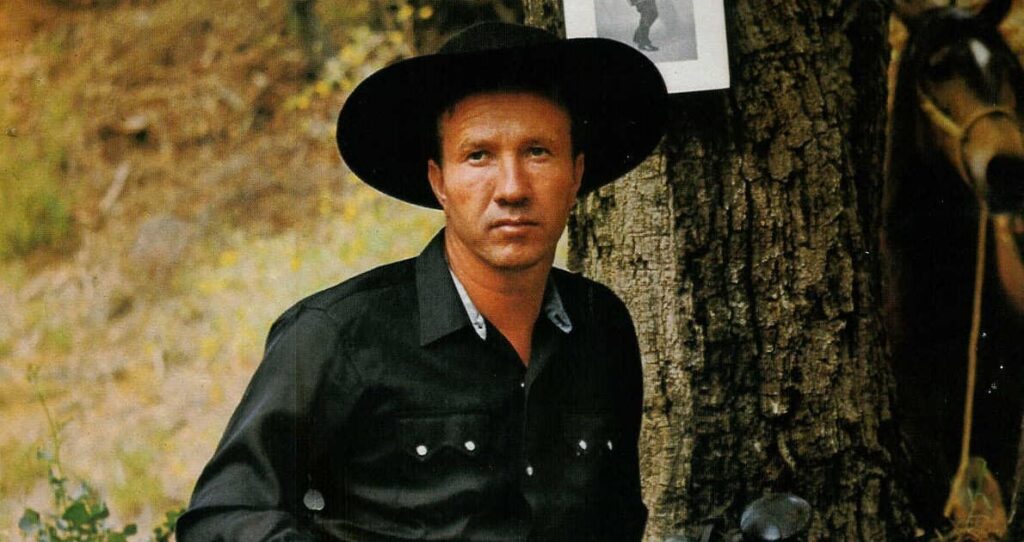
A free-hearted ode to the timeless spirit of the open range
Doggone Cowboy by Marty Robbins, from his 1963 album Return of the Gunfighter, is not just a Western ballad it is a celebration of nomadic freedom, a humble confession of a life lived under the wide sky, and a gentle yet determined affirmation of one man’s inevitable path. While the track itself was not released as a major single that charted on its own, the album Return of the Gunfighter made a strong impression, eventually reaching No. 8 on the newly created Billboard Country Album Chart in early 1964 and remaining there for 12 weeks.
The song was written by Joe “Cowboy Joe” Babcock, a prolific western songwriter who collaborated often with Robbins. Its lyrics paint the portrait of a cowboy born to ride the dusty trails: “I’m kin to the rovin’ wind… Along that dusty trail I’ll take my stand.” Robbins sings of long cattle drives, brandings, cold nights, and endless horizons all with a touch of wistful humor and a plainspoken certainty that this is his place, even if he has “no home … no wife.”
In his voice and performance, Robbins captures both the romantic ideal and the practical hardship of cowboy life. He doesn’t romanticize poverty or loneliness instead, he embraces them as part of the rich tapestry of his identity. The joyful refrain, “But I’ll be a doggone cowboy all of my life,” is not a boast so much as a declaration of belonging. Even when the hot dry wind blows or when the rain and the snow come, he remains undeterred, warmed by campfires, kept company by memories and song.
This song’s meaning resonates deeply: it is about freedom, perseverance, and a choice to live unbound by conventional expectations. As Marty Robbins himself often did, the cowboy in this song rejects the settled life. But this is not a regretful or tragic rejection quite the contrary. The cowboy’s restlessness is his strength, and his acceptance of a rugged life is presented with pride mingled with gentle humility.
Although Doggone Cowboy did not top the singles charts, its presence on Return of the Gunfighter contributed greatly to the album’s success, and it has become one of the most beloved tracks in Robbins’ western repertoire. The album’s producer duo, Don Law and Frank Jones, helped Robbins create a record that felt authentic, steeped in the sounds and stories of the Old West.
Over the decades, Doggone Cowboy has endured in the hearts of listeners who long for the freedom of the open range, who understand the lonely call of the trail, and who admire the cowboy’s quiet courage. For those who grew up hearing Robbins’ rich, clear baritone on the radio, or on old vinyl records spun under dim porch lights, the song is a warm memory a reminder of a time when music told stories of rugged individuals and endless horizons.
In listening today, one hears more than a Western ditty. One hears a life philosophy: to ride on, to accept the uncertainty of the trail, to find companionship in a boarding photograph, and ultimately to say with calm resolve, “I’ll be a doggone cowboy all of my life.” It is a tribute not only to the mythic West, but to the spirit of anyone who ever believed that freedom was worth the cost.
 Oldies Songs