
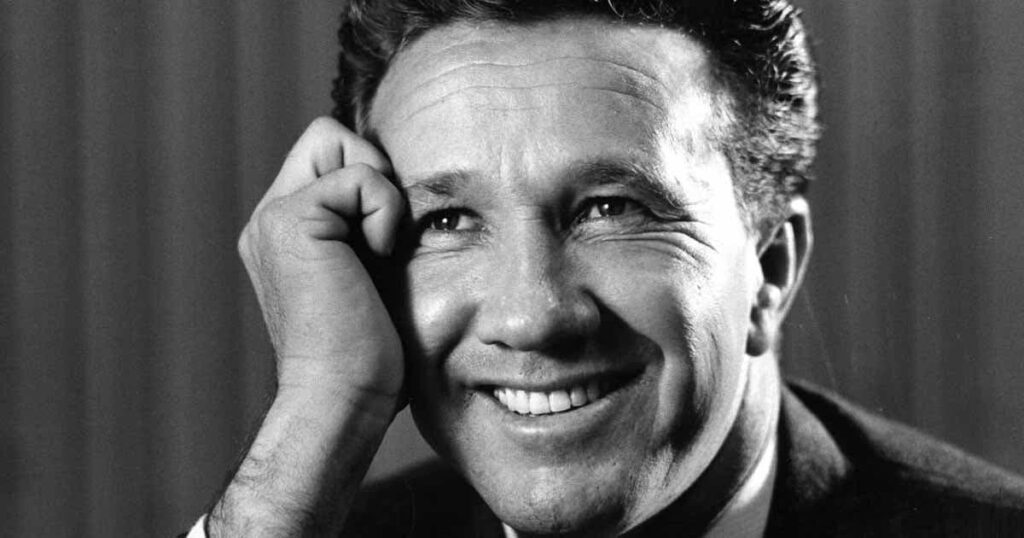
A haunting western lament of an outlaw haunted by love and his own gunslinger past “Running Gun” by Marty Robbins
“Running Gun” is a deeply reflective, tragic ballad in which Marty Robbins gives voice to a lone gunfighter tortured by regret, lost love, and the relentless weight of his violent life.
“Running Gun” first appeared in 1959 on Robbins’ seminal album Gunfighter Ballads and Trail Songs, a landmark collection that cemented Robbins as one of the greatest storytellers in country and western music. The album itself was a major success, peaking at #6 on the Billboard 200 chart, and it remains widely regarded as a classic of the western ballad genre. While “Running Gun” was not released as a separate chart-topping single, it was featured as the B-side to the hit “El Paso” when that single came out on October 26, 1959.
The story behind “Running Gun” is as cinematic as the sweeping landscapes of the Old West. The song was written by Tompall Glaser and Jim Glaser, and Robbins recorded it during his April 7, 1959 session for what became the Gunfighter Ballads album. Robbins’ performance is vivid and raw: the outlaw narrator rides out of Kansas City, heading “south to Mexico,” haunted by a past marked by danger, violence, and death.
As the lyrics unfold, we learn he has “twenty notches on my six-gun,” a haunting detail that speaks to all the men he’s killed and the lessons he’s paid for in blood. He sold his gun more than once just to find a place to rest, but memories of those he killed always pursued him. In a moment of desperate longing, he says goodbye to Jeannie, the woman he loves, and vows to send for her once he reaches Mexico.
However, that plan ends in tragic confrontation. As he enters Amarillo at sunset, he’s challenged by a bounty hunter who knows his reputation and life catches up with him in a final, fatal showdown. His strength fades; he realizes his end is near. In his last moments, he pleads for someone to tell Jeannie that she was always the only one, but acknowledges with heartbreak that “a woman’s love is wasted when she loves a running gun.”
The meaning of “Running Gun” goes well beyond a tale of guns and duels. According to music analysts, the “running gun” is not just a fast pistol but a symbol of the man’s identity, his burden, and his curse: the life he chose has shaped him, haunted him, and doomed him to a lonely, violent fate. His love for Jeannie is genuine and deep, but his path and actions make a normal life impossible. He yearns for redemption and peace, but his past crimes and the nature of his life make that peace unattainable.
Musically, the song is delivered with Robbins’ trademark clarity and restraint. The arrangement is spare yet evocative: minimal instrumentation, a steady rhythm, and perhaps the subtle echo of guitar lines that feel like hoofbeats across a dusty trail. His voice carries both strength and resignation, giving the narrative genuine emotional weight.
“Running Gun” holds a special place within the Gunfighter Ballads and Trail Songs album. While “El Paso” often gets the spotlight, “Running Gun” complements it perfectly: where El Paso is a romantic, fiery duel, “Running Gun” is more somber a meditation on what comes after the bullets, on memory, loss, and regret. In many ways, it’s one of the most morally complex and emotionally honest songs Robbins ever recorded.
For older listeners who remember the golden age of country radio or who grew up hearing stories of the Old West spun into song, “Running Gun” evokes a powerful nostalgia. It calls to mind long, lonely trails, campfires under endless skies, and the bittersweet cost of lives lived on the edge. You feel the outlaw’s longing, his regrets, and the heavy truth that some lives don’t end with glory only with the silent acknowledgment that love, for all its power, sometimes cannot tame a soul shaped by the gun.
In the end, Marty Robbins’ “Running Gun” remains more than just a western ballad it is a haunting, timeless testament to the price of violence, the pull of memory, and the sadness of a heart that cannot rest. It is storytelling in its purest form, and a reminder that behind the myth of the gunfighter lies a human being carrying regrets heavier than any weapon.
 Oldies Songs