
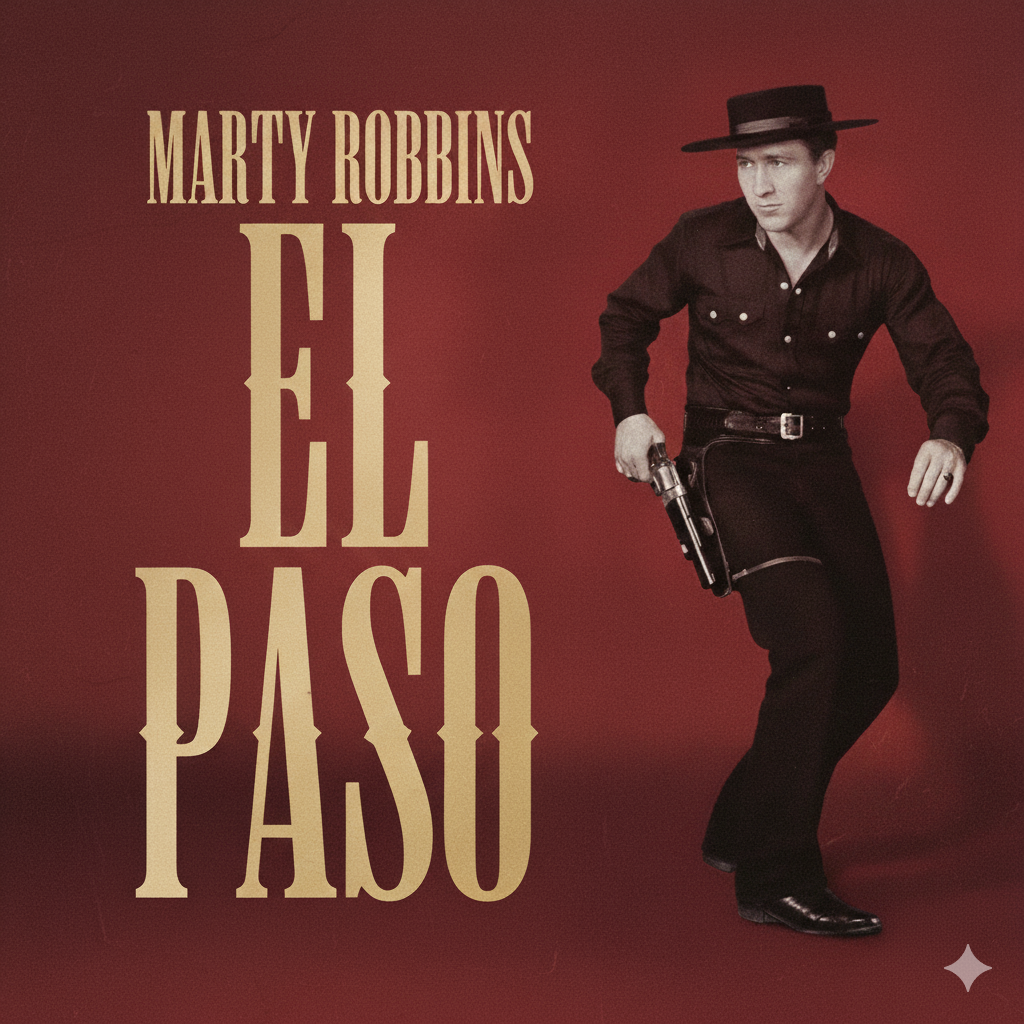
A heartbreaking Western ballad of love, violence, and fate “El Paso” by Marty Robbins
“El Paso” is a vivid, lyrical saga of a cowboy’s fiery love and tragic destiny, told with the gentle strength of Marty Robbins’ voice.
When Marty Robbins released “El Paso” in 1959, it was nothing like the typical country single of its time. At over 4 minutes long (some versions run around 4:37), it defied radio norms. Yet, against expectations, the song climbed to #1 on the Billboard Country chart, holding that position for seven weeks. Even more remarkably, it crossed over to the pop chart, reaching #1 on the Billboard Hot 100, making it a rare and powerful crossover hit. In 1961, “El Paso” won the Grammy Award for Best Country & Western Recording, cementing its status as one of Robbins’ signature masterpieces.
Behind the haunting melody lies an unforgettable story. Robbins, inspired by Old West imagery and the rich cultural tapestry of the Texas–Mexico border, crafted a tale set in Rosa’s Cantina in El Paso. The narrator, a young cowboy, falls passionately in love with Feleena, a Mexican dancer. His love ignites jealousy when another man flirts with her, and in a moment of desperation, he kills his rival. Forced to flee, the cowboy rides into the badlands, haunted by regret. But the flames of love pull him irresistibly back; he returns to El Paso, knowing the risk. Tragically, as he approaches, he is shot by a posse. In his final moments, he clings to Feleena, imagining her arms around him in a bittersweet farewell.
What makes “El Paso” so powerful is Robbins’ masterful songwriting and the way his arrangement supports the story. The opening guitar, played by Grady Martin, has a distinctive Spanish-influenced flair that sets the emotional tone immediately. Backing harmonies notably by Bobby Sykes and Jim Glaser add haunting richness, and Robbins’ smooth, warm vocal delivery makes the cowboy’s confession both intimate and epic.
More than just a love story, “El Paso” is a meditation on fate, honor, and the cost of obsession. The cowboy’s decision to return, despite knowing the danger, speaks to a love that is unreasoning and all-consuming. The song’s tragic ending death in Feleena’s arms feels inevitable, yet it resonates as deeply human. Robbins doesn’t glamorize the violence; he humanizes it, showing his character’s vulnerability, longing, and fatalism in equal measure.
The song’s length and narrative structure were a gamble. Columbia Records was initially uneasy: a Western ballad over four minutes long didn’t match the typical radio single. They even released an edited version for radio, but disc jockeys preferred to play the full, unabridged track. That choice paid off listeners were drawn into the full story, not just a fragment of it.
Over time, “El Paso” has become more than a hit song it is a country music classic. The Western Writers of America named it one of the Top 100 Western songs of all time. Its emotional depth, narrative ambition, and musical elegance make it a touchstone for storytelling in song.
For listeners who remember hearing this ballad on the radio late at night or spinning on a vinyl record, “El Paso” brings back a strong sense of nostalgia: the heat of the desert, the loneliness of a long ride, the ache of unrequited or dangerous love. It’s a song that invites reflection on love’s power, on the choices we make, and on how fate often has its way.
In the end, Marty Robbins did more than write a country song he painted a vivid scene, created a heartbreaking character, and delivered a timeless tale in melody and voice. “El Paso” remains a testament to the art of storytelling in music and the emotional endurance of a ballad well told.
 Oldies Songs